

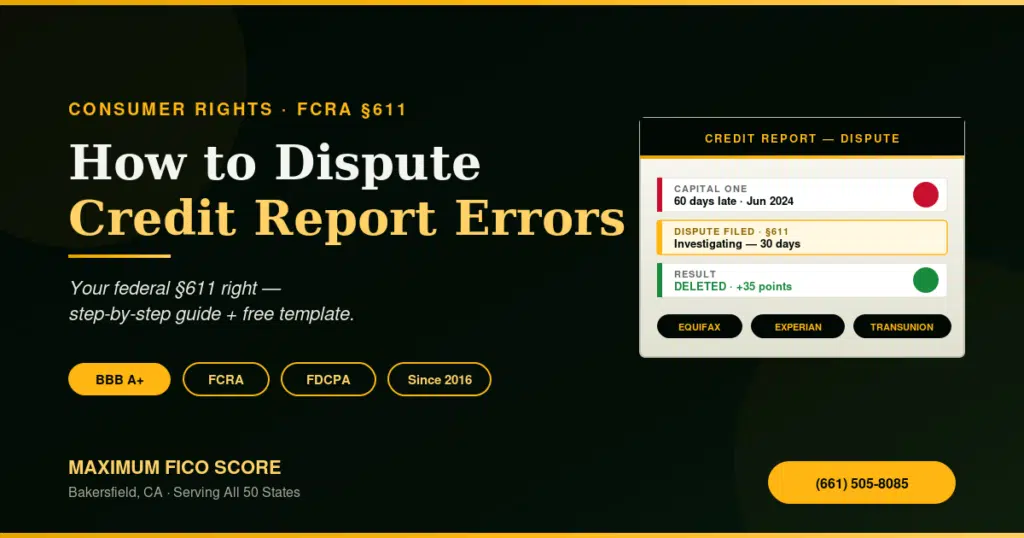
Quick Answer: Under FCRA Section 611, credit bureaus must complete their dispute investigation within 30 days — or 45 days if you submit additional documentation. If a bureau fails to meet this deadline, the disputed item must be deleted from your credit report. You may also have legal grounds to sue the bureau for willful noncompliance under FCRA Section 616 or 617, which can include actual damages, statutory damages, and attorneys’ fees.
The FCRA 30-Day Investigation Clock Explained
The Fair Credit Reporting Act sets a strict timeline for credit bureau dispute investigations. Once a bureau receives your dispute, the clock starts. Here is exactly how it works:
- 30-day standard window: The bureau must complete its investigation and notify you of the results within 30 days of receiving your dispute
- 45-day extended window: If you submit additional relevant documentation after your initial dispute, the bureau gets a one-time extension to 45 days total
- 5-day notification requirement: If the bureau re-inserts a previously deleted item, it must notify you within 5 business days
- Deletion by default: If the bureau cannot verify the disputed information within the investigation window, it must delete or modify the item
The “Frivolous Dispute” Loophole Bureaus Use to Avoid Investigating
Credit bureaus have one major legal escape hatch: they can decline to investigate a dispute they deem “frivolous or irrelevant.” Under FCRA Section 611(a)(3), a bureau may skip the investigation if it reasonably determines that the dispute lacks sufficient information or is substantially the same as a previous dispute for which there is no new information.
In practice, this means that vague or repetitive dispute letters — the kind often generated by low-quality credit repair templates — can be rejected without any investigation at all. The bureau must notify you within 5 business days that it is classifying the dispute as frivolous and explain why. If you receive this notice, you have the right to resubmit with additional specifics and documentation.
This is why a well-documented, specific dispute letter is essential. The more detail you provide — account number, exact inaccuracy, supporting evidence — the harder it is for a bureau to classify your dispute as frivolous.
How to Document Non-Response and Create a Paper Trail
If you believe a bureau has missed its deadline or failed to properly investigate your dispute, documentation is everything. Here is how to protect yourself:
- Always send disputes via certified mail with return receipt. This gives you legal proof of the exact date the bureau received your dispute letter.
- Keep a copy of every letter you send. Note the date, the specific items disputed, and the grounds for each dispute.
- Calendar the deadline. Count 30 days from the confirmed delivery date. If you do not have a written response by that date, the clock has run.
- Save every response you receive — including letters saying the dispute is under review, verified, or frivolous.
- Request your updated credit report immediately after the 30-day window to see whether the disputed item was removed or modified.
Your Right to Sue Under FCRA Section 616 and 617
The FCRA gives consumers real legal teeth when bureaus fail to follow the rules. Under Section 616 (willful noncompliance) and Section 617 (negligent noncompliance), you may be entitled to:
- Actual damages — provable financial harm caused by the inaccuracy (e.g., a loan denial, higher interest rate)
- Statutory damages — between $100 and $1,000 per violation if the violation was willful, even without proving actual harm
- Punitive damages — additional amounts a court may award in cases of willful, reckless violation
- Attorneys’ fees — meaning many FCRA attorneys take these cases on contingency because the law requires the bureau to pay fees if you win
Before pursuing litigation, most consumers file a complaint with the Consumer Financial Protection Bureau (CFPB) at consumerfinance.gov/complaint. A CFPB complaint creates an official record and often prompts faster resolution from the bureaus than a dispute letter alone.
Sample Certified Mail Follow-Up Letter (After 30 Days of No Response)
If your 30-day window has passed with no response, send a follow-up via certified mail that includes:
- Reference to your original dispute letter and its certified mail tracking number
- The confirmed delivery date (triggering the 30-day clock)
- A statement that the investigation deadline has passed
- A demand for immediate deletion of the disputed item under FCRA Section 611(a)(5)(A)
- Notice that you are preserving your right to file a CFPB complaint and pursue legal remedies under FCRA Section 616/617
If you are currently dealing with a dispute that has gone past the 30-day window without resolution, contact Maximum FICO Score for a free assessment. We can help you understand exactly where your dispute stands and what your next steps should be under federal law.
If a bureau fails to complete its investigation within 30 days (or 45 days with additional documentation), it must delete the disputed item from your credit report.
Yes. Under FCRA Section 611(a)(3), a bureau can decline to investigate a dispute it deems frivolous or irrelevant, but it must notify you within 5 business days and explain why.
Send disputes via certified mail with return receipt, keep copies of every letter, calendar the 30-day deadline from the confirmed delivery date, and save every response the bureau sends.
Yes. Under FCRA Sections 616 and 617, you may be entitled to actual damages, statutory damages of $100 to $1,000 per violation, punitive damages, and attorneys’ fees.
Disclaimer: This content is educational and does not constitute legal advice. For legal questions about FCRA violations, consult a licensed FCRA attorney. Maximum FICO Score operates in compliance with the FCRA, FDCPA, and CROA. Results vary by individual credit profile.